Reflective Accounts and Gibbs’ Reflective Cycle
Study Skills For Apprentices
A reflective account is a written record where you thoughtfully review a real-life situation, analyse your actions, identify what you learned, and consider how you can improve. Reflective accounts help bridge the gap between theory and practice, giving you the opportunity to connect what you are learning in your apprenticeship with your role in the workplace.
Reflective writing is widely used across healthcare, social care, education and business settings. It supports professional development by encouraging you to think carefully about your experiences, your decisions, your communication, and the impact of your actions on others.
At Dynamic Training, reflective journal entries are an important part of your apprenticeship journey. They are not about writing perfectly. They are about developing your confidence, recognising your progress, and identifying practical ways to strengthen your skills. Preparing and writing your reflective accounts are part of your off the job learning, so as well as supporting your development of new knowledge skills and behaviours as part for your apprenticeship they also can be logged as off the job learning hours.
Advice from Our Skills Development Coaches
“Use the 'how to' link on the learning journal that showcases the reflective cycle to help you to write reflections. It's important to start small - write short journal entries until you get used to reflective practice. Choose simple topics to start with, ie something you learned that week. Reflections are personal to you - include what you want!"
Sharon Antony, Skills Development Coach – SHSW Maternity
“I coach my learners to use Gibbs’ Reflective Cycle to write reflections. If they answer the relevant questions in each section, they usually have a pretty good reflection by the end. It is a helpful way to get started.”
Michaela Ford, Skills Development Coach – SHSW Theatres
“Think about what you have done and how you are going to use it in the workplace. For example, if you have read an updated care plan, you could reflect on what has changed and how you will implement those changes, such as using a client’s new activity plan.”
Margaret Barker, Training Manager
“Use a model of reflection. I have suggested Gibbs’ Reflective Cycle to learners many times over the years because it gives a clear structure and helps learners organise their thoughts.”
Caroline Ratcliffe, Skills Development Coach – Healthcare Science
"In your reflective account, always say: WHAT you did-- WHY--(this is important because....)-- HOW--- and CONSEQUENCES (of doing/not doing)!"
Kate Richard, Skills Development Coach – SHSW Allied Health
"Imagine you are on holiday, you are taking a picture of your last night. Why? so you can remember that holiday or event. Your picture is words, list everything you can to allow you to remember everything, the smell of the air, the warmth of the sand, the smell of the food, the taste of the drink. so when you read the reflection back, you can relive the experience."
Kevin Fitzgerald, Commercial Programmes Tutor
Why Reflective Practice Matters
Reflective practice supports your development throughout your apprenticeship and beyond. It helps you build confidence, recognise progress, and identify areas where you may need further support or development.
It can also help you:
- Improve your self-awareness
-
Strengthen your communication skills
-
Develop critical thinking
-
Understand the impact of your actions
-
Make links between theory and practice
-
Prepare for future workplace situations
-
Take ownership of your professional development
Most importantly, reflection helps you recognise that learning is an ongoing process. Every workplace experience, whether positive, challenging or unexpected, can support your growth.
Using Gibbs’ Reflective Cycle
Gibbs’ Reflective Cycle is a popular model of reflection that can help you structure your journal entries. It was developed by Graham Gibbs and is widely used in education, healthcare, social care and professional development.
The model takes you through six stages. Each stage asks you to think about a different part of your experience, helping you move from description to learning and action.
The six stages are:
-
Description – What happened?
-
Feelings – What were you thinking and feeling?
-
Evaluation – What was good and what was challenging about the experience?
-
Analysis – What sense can you make of the situation?
-
Conclusion – What else could you have done?
-
Action Plan – If it happened again, what would you do?
Using this structure can make reflective writing feel more manageable, especially if you are unsure where to begin.
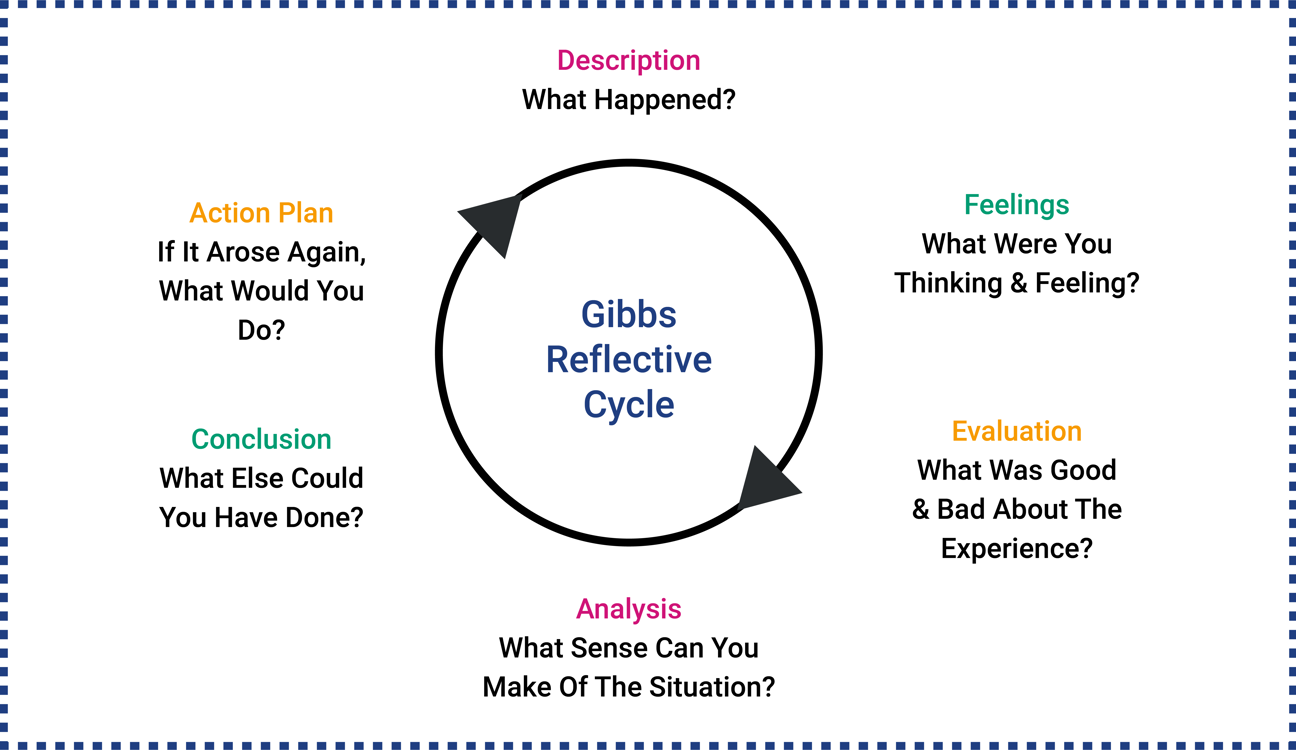
The Six Stages of Gibbs’ Reflective Cycle:
At this point, try not to analyse or judge what happened. Simply describe the experience clearly.
You could include:
-
What happened
-
When and where it happened
-
Who was involved
-
What your role was
-
What actions were taken
-
What the outcome was
For example, you may reflect on supporting a patient, completing a workplace task, reading an updated care plan, communicating with a colleague, attending training, or receiving feedback.
A clear description gives you a strong foundation for the rest of your reflection.
2. Feelings: What were you thinking and feeling?
The second stage encourages you to explore your thoughts and emotions.
You might consider:
-
How you felt before the situation
-
How you felt during the experience
-
How you felt afterwards
-
What you were thinking at the time
-
Whether your feelings affected your actions
-
How others may have felt
Try to be honest and transparent. Reflection is personal to you, and there is no need to write what you think sounds “perfect”. The purpose is to understand your experience and learn from it.
3. Evaluation: What was good and what was challenging?
The third stage asks you to evaluate the experience.
This means thinking about both the positive and negative aspects of what happened.
You could ask yourself:
-
What went well?
-
What did I do effectively?
-
What did others do effectively?
-
What did not go so well?
-
Were there any challenges?
-
What feedback did I receive?
-
What was the impact on others?
Try to keep your evaluation balanced. Avoid being overly critical of yourself. The aim is to learn, not to judge yourself harshly.
4. Analysis: What sense can you make of the situation?
The fourth stage helps you look more deeply at why things happened.
This is where you connect your experience to your learning, workplace standards, policies, procedures or professional expectations.
You may want to ask:
-
Why did things happen the way they did?
-
Why did something go well?
-
Why was something difficult?
-
What knowledge or skills did I use?
-
What could have influenced the outcome?
-
Did communication, confidence, teamwork or preparation play a role?
-
How does this link to my apprenticeship learning?
This stage helps you move beyond description and show deeper understanding.
5. Conclusion: What else could you have done?
The fifth stage brings together your learning.
You should consider what you now understand as a result of the experience.
You could write about:
-
What you learned
-
What you would do differently next time
-
What you would do again
-
What skills you need to develop
-
What support or guidance may help you
-
How the experience has changed your understanding
This section helps show how you are developing as a learner and as a professional.
6. Action Plan: What would you do next time?
The final stage focuses on your future practice.
This is where you identify practical actions you can take if a similar situation happens again.
Your action plan could include:
-
Reading relevant workplace guidance
-
Asking your manager, mentor or Skills Development Coach for support
-
Practising a particular skill
-
Improving how you communicate
-
Preparing more thoroughly
-
Applying feedback
-
Using new knowledge in your role
-
Reviewing policies, procedures or care plans
This stage is important because it shows how you will use your reflection to improve your confidence, practice and professional development.
Tips For Writing Reflective Journal Entries
Reflective writing becomes easier with practice. You do not need to write a long or complex entry every time.
Start Small
Begin with short reflections on simple topics. For example:
- Something you learned during the week
- A conversation that helped your understanding
- A task you completed for the first time
- Feedback you received
- A situation that improved your confidence
- A challenge you managed in the workplace
Short, regular reflections can be more useful than waiting until you have a large event to write about.
Be Specific
Try to focus on one clear situation rather than writing generally about your whole week.
For example, instead of writing:
“I learned about care plans.”
You could write:
“I read an updated care plan and identified changes to the individual’s activity plan. I reflected on how I would use this information to support the person safely and consistently.”
This makes your reflection clearer and easier to connect to your workplace practice.
Keep confidentiality in mind
When writing about workplace experiences, do not include personal details that could identify patients, clients, service users, colleagues or organisations.
Use general terms such as:
- “A patient”
- “A service user”
- “A colleague”
- “A member of the team”
- “The workplace setting”
This helps maintain professionalism and confidentiality.
Link Reflection To Your Role
A strong reflective account explains how the experience connects to your apprenticeship and workplace responsibilities.
You may want to mention:
- Skills you used
- Knowledge you applied
- Behaviours you demonstrated
- Policies or procedures you followed
- Communication or teamwork
- How the experience supports your development
This shows that you are not only describing what happened, but also understanding its professional importance.

Dynamic Training are experts in Healthcare Education. Follow our blog for the latest industry news, insight and advice from industry experts.

Dynamic Training has an expert team of trainers delivering high-quality apprenticeships across the health, social care and business sectors, making sure you get the best out of your workforce.

Dynamic Training cares deeply about creating an inclusive and accessible enviroment for our learners. We have a proud record of getting the best out of every learner and adjusting our training to suit them.
Learn more about how Dynamic Training has provided a positive and inclusive learning environment.